We all want our passion projects to scale, right? We dream of that “hockey stick” growth, the massive influx of users, and the web traffic that breaks the internet.
Well, this week, AWS decided my humble $20-a-month architecture was ready for the big leagues.
On July 17, 2026, I—along with developers around the globe—received a budget alert. It wasn’t just a few dollars over.
According to the email I received, my actual cost associated with my ‘Monthly Plan’ budget was running just a little bit high…
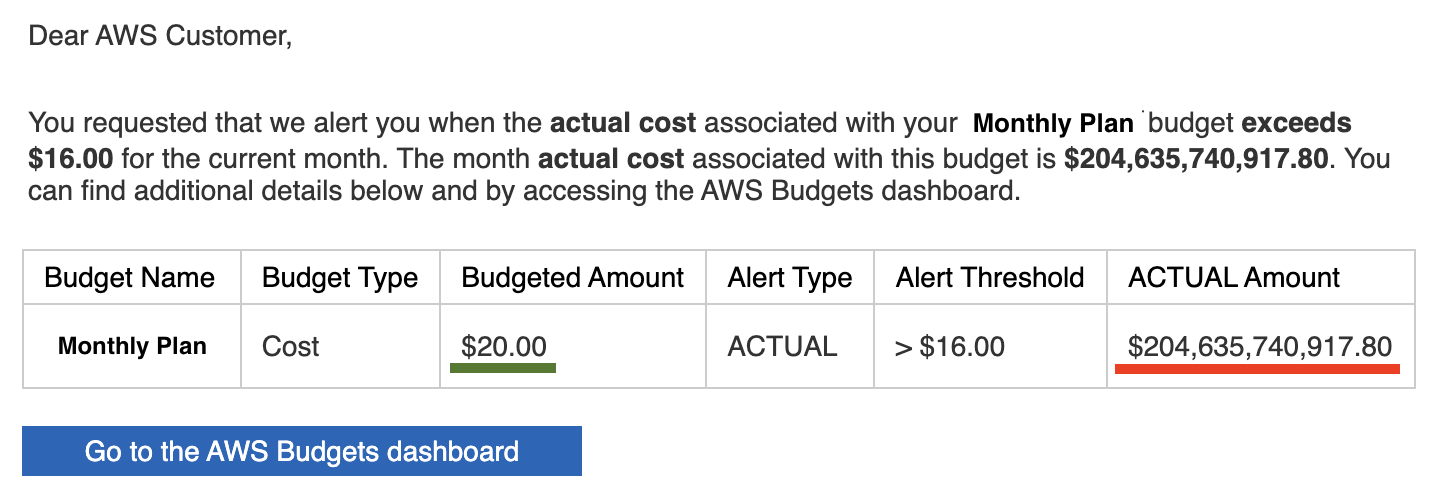
Yes, you are reading that correctly:
- Budgeted Amount: $20.00
- ACTUAL Amount: $204,635,740,917.80
I have to hand it to the AWS billing algorithm; it is incredibly confident in my tiny personal site’s resource consumption. It takes a truly visionary computation subsystem to look at a static S3 bucket and a single EC2 micro instance and decide I’ve already consumed the GDP of a small nation by mid-month!
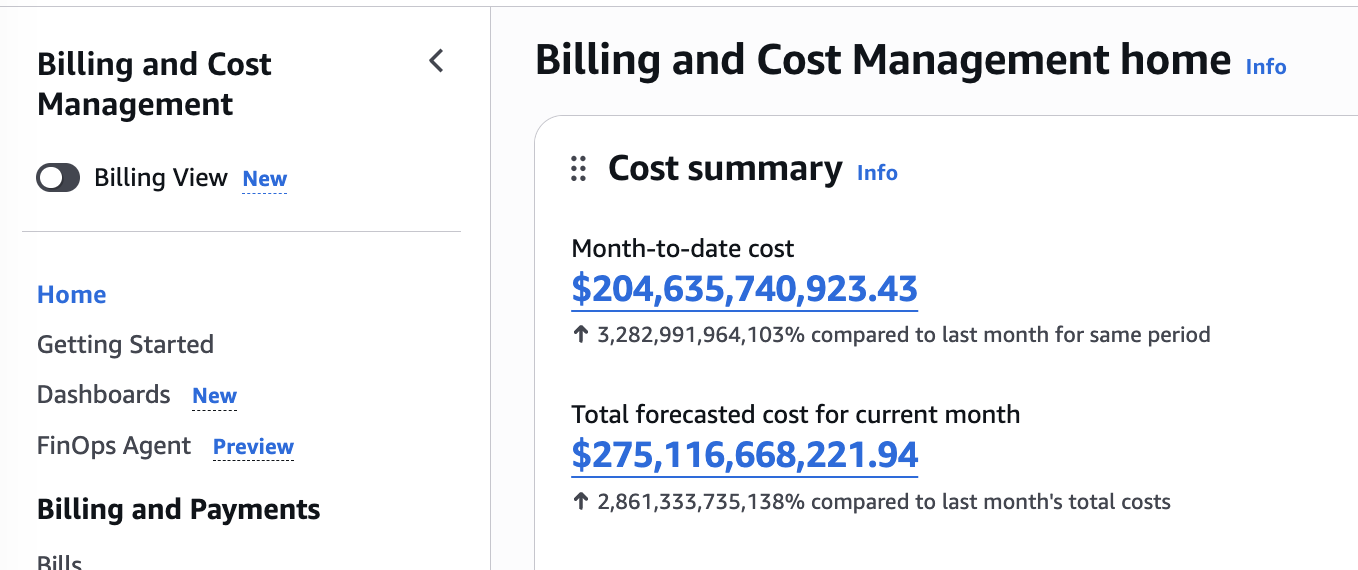
(Note: If you are wondering what my dashboard looked like, check out the cover image of this article. It even shows a 3 trillion percent cost increase compared to last month!)
Of course, this turned out to be a system-wide unit pricing glitch in the billing display, not actual charges. My bank account is safe, and I didn’t have to flee the country.
However, since I am deeply appreciative of this spontaneous cardiovascular stress test, I have put together a few humble, highly innovative feature recommendations for the AWS team to consider for their next sprint.
💡 Innovative Feature Requests for the AWS Billing Console
Since AWS is always at the cutting edge of cloud technology, here are a few ways they could enhance the user experience around these “ambitious” billing calculations:
1. “SanityCheck as a Service” (SCaaS) Right now, the budget alerting system operates with unparalleled, lightning-fast efficiency. It sees a $204 billion actual cost on a $20 budget and instantly fires off an email without hesitation. Such confidence! But perhaps we could introduce a premium feature—let’s call it SCaaS. If an account’s current bill exceeds the cost of the Apollo space program, a small, automated algorithm might pause and say, “Hey, maybe let’s have a human look at this before we email this poor developer?” I would gladly pay an extra $0.05 a month for this level of AI-driven doubt.
2. The “Opt-Out of Bankruptcy” Button Currently, AWS empowers developers with infinite scalability. We love this! But what if, just as a fun, quirky alternative, we had a “Hard Stop” button? Imagine a magical toggle that simply turns off my compute resources when my bill hits $20. Sure, my app would go offline, but I wouldn’t have to wonder if I need to liquidate my assets to pay for a rogue Lambda function. It could be a niche feature for those of us who prefer to remain solvent!
3. Context-Aware Alert Formatting If an alert is going to exceed $100 billion, standard email text feels a bit too casual. A milestone like this deserves fanfare. Perhaps the alert could include a digital certificate of achievement for single-handedly funding Amazon’s next space mission, or at least a complimentary wellness voucher for the resulting panic attack.
The Takeaway
In all seriousness, if you woke up to an astronomical bill this week, take a deep breath. Your actual usage is fine, your infrastructure is safe, and you do not owe trillions of dollars. Do not go nuking your entire AWS account in a panic!
Have you ever received a heart-stopping alert from a cloud provider? How did you handle it?